Happenings: New York, 1958-1963

Happenings: New York, 1958-1963 is easy to use products that have been steamed. It can be easily carried over to other products in this class. At first, my friend purchased Happenings: New York, 1958-1963 used. It gives me great pleasure. After that, my friend has recommended me to try Happenings: New York, 1958-1963. It appears that I can use it like that. I had to buy it as their own. The price is not expensive as I thought. AVC and functionality. It is easy to use. The manual is easy to understand. And Happenings: New York, 1958-1963 looks beautiful. After I use while I have to get people to buy Happenings: New York, 1958-1963. Where everyone is satisfied that it is very much to have in his possession. If you are looking for products that are similar to what it is. I highly recommend it, you will not regret buying Happenings: New York, 1958-1963.

Happenings: New York, 1958-1963 Overview
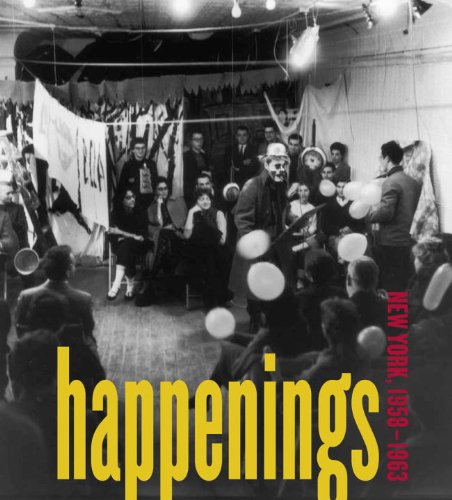
In early October 1959, thirty-two-year-old Allan Kaprow presented a performance piece entitled "18 Happenings in 6 Parts." This unique conjunction of visual, aural, and physical events, performed for an intimate art world audience by his friends and colleagues, would change the course of art history. The genre of artwork that evolved from this debut would become known as Happenings.
This new volume provides a comprehensive look at this revolutionary art form. Prepared in conjunction with an exhibition at the Pace Gallery in New York, it focuses on the years that saw the movement's birth in New York and Provincetown, Mass., and the artists who made the genre a legend: Red Grooms, Allan Kaprow, Robert Whitman, Jim Dine, Claes Oldenburg, Simone Forti, Carolee Schneemann. Together, they created a new and outrageous art form with an "anything goes" attitude, one whose influence is still felt within the contemporary art world.
Author Mildred Glimcher, an art historian, author, and close observer of contemporary art for more than fifty years, provides a vivid and comprehensive look not only at the genre, but also at the culture and society that surrounded it. She visits the formative years of the movement in great detail, describing each performance piece in words and photographs. The radical nature of the time and the works is evidenced by Red Grooms's The Burning Building, Claes Oldenburg's Ray Gun Spex, Jim Dine's A Shining Bed, and many more. Happenings is heavily illustrated with photographs from the era, many drawn from a previously unpublished cache by Robert McElroy.
